Converting Talent into Capital: The Global Quantum Ecosystem
7% of the quantum founders identified worldwide are French. Over the 2017-2026 decade, France captured only 5.2% of global venture capital invested in the sector, and a comparable share, about 3.9%, of cumulative enterprise value. Between producing talent and converting it into capital, a gap is widening, measurable and recurring.
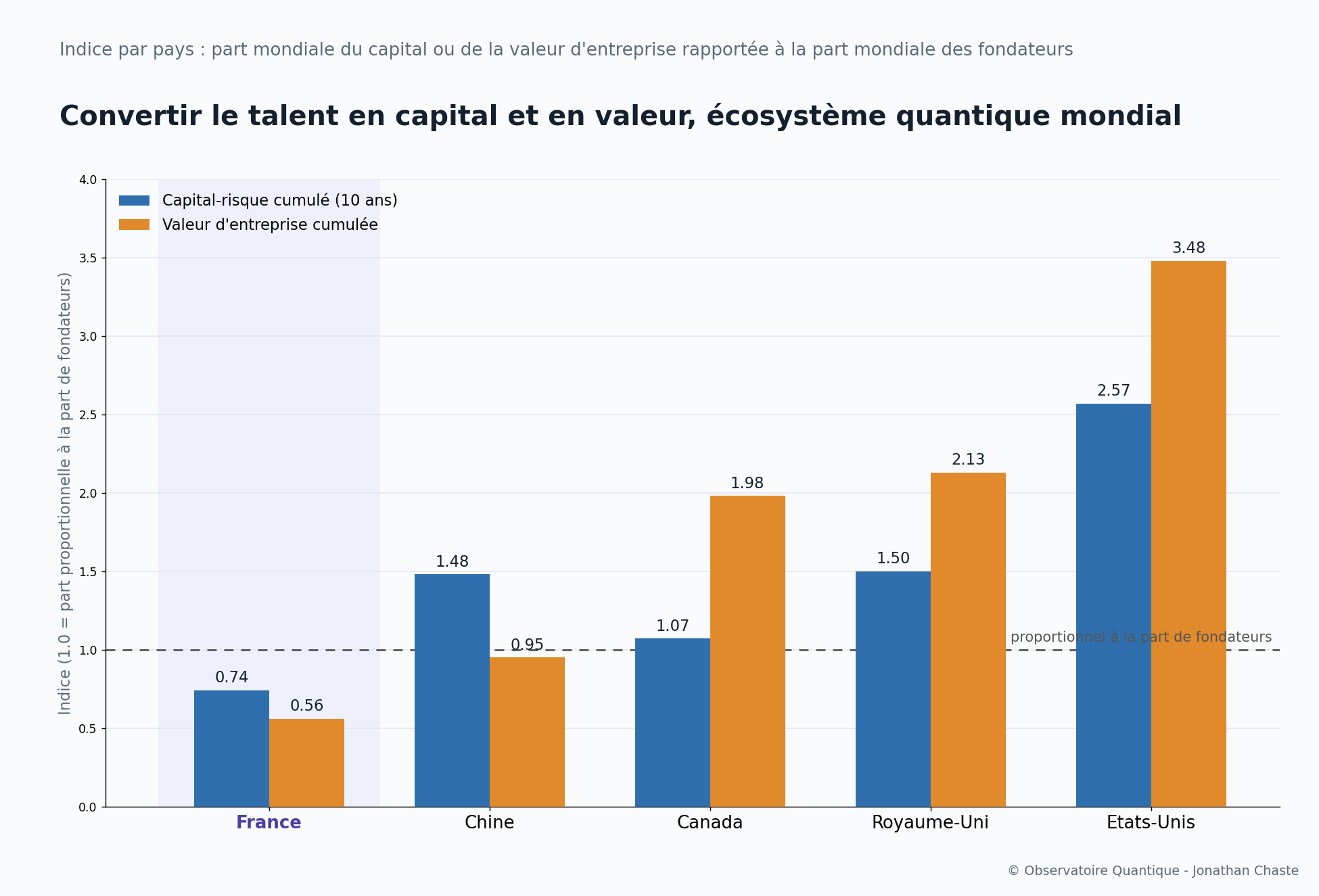
Relative to its weight in founders, France shows an index of 0.74 for cumulative venture capital and 0.56 for valuation. Below the 1.0 threshold, a country exports more value creation than it captures on its own territory. China, with indices of 1.48 and 0.95, sits in an intermediate position. Canada and the United Kingdom already clearly exceed parity.
In the United States, the index reaches 2.57 for capital and 3.48 for valuation. Capital does not merely follow American talent, it precedes it, attracts it and retains it, including when that talent was trained elsewhere. This is a well-known agglomeration mechanism in venture capital, but rarely documented with this precision on the quantum computing segment alone.
A fundamental movement, still recent, is nevertheless starting to alter this reading. The share of global venture capital allocated to quantum has risen sharply in Europe since 2022, from close to zero to 3.3% of total European venture capital in 2026. Over the same recent period, this share has fallen in the United States, from nearly 1% to 0.1%. Two readings remain possible at this stage: a structural European catch-up, or a base effect linked to the strong growth of total American venture capital, driven by artificial intelligence, which mechanically dilutes the relative share of quantum without its absolute volume necessarily declining.
For an investor or a sovereign fund assessing exposure to the sector, the reading is direct. France, and more broadly continental Europe, produces a pool of talent and intellectual property that it does not yet value in proportion to what it produces. This is an entry point for patient capital positioned early, not a structural weakness bound to last as it is.